Abstract
"XInfinitum" — Without end, without limit. A network whose keys are born from quantum infinity and vanish just as fast.
Every transaction signed by a key that has never existed before and will never exist again.
XInfinitum is a novel Layer 1 blockchain that combines AI-driven consensus, zero-knowledge machine learning (zkML) proofs, quantum-derived transaction keys, and post-quantum encrypted token storage to produce a network that is simultaneously transparent in its decision-making, accountable in its transaction history, and the most secure signing infrastructure ever built for a public blockchain.
The XInfinitum network replaces traditional Proof-of-Stake validators with a diverse ecosystem of staked AI agent validators, each running distinct proprietary models. These agents reach Byzantine Fault Tolerant (BFT) consensus on block validity and publish cryptographic proofs of every decision to a public proof ledger — making the consensus process independently verifiable by anyone, anywhere, without revealing the AI models themselves.
By default, XInfinitum operates as a pseudonymous ledger in the tradition of Bitcoin and Ethereum: wallet addresses are public, transaction amounts are visible on-chain, and the full transaction graph is auditable by anyone. For users who require enhanced financial privacy, XInfinitum provides an opt-in Enhanced Privacy Mode that activates ring signatures, stealth addresses, and Pedersen commitment amount concealment on a per-transaction basis.
Most distinctively, XInfinitum introduces Quantum State Keys — wallet signing keys that do not exist in persistent storage. Derived from quantum random number generation at the exact moment of signing and immediately discarded thereafter, Quantum State Keys make it cryptographically impossible to steal a private key that never persisted long enough to be stolen.
1 · The Problem
1.1 The Validator Trust Problem
Proof-of-Stake consensus relies on economic incentives to align validator behavior with network interests. This model carries structural weaknesses:
- Software homogeneity: Most validators run identical client software. A single zero-day exploit can cascade across the entire validator set simultaneously.
- Validator concentration: The largest stakers exert disproportionate influence over both consensus and governance.
- No active intelligence: Deterministic validators check whether transactions follow rules but cannot detect novel attack patterns, flash loan attacks in formation, or emerging threats before they execute.
- Opaque decision-making: There is no public record of how a validator reached its decision — only what was decided.
1.2 The Key Storage Problem
Every classical wallet — software, hardware, paper — stores a static private key. This key signs every transaction the wallet ever makes. A single breach exposes the wallet's entire history and all future funds permanently. There is no forward secrecy and no recovery.
1.3 The Quantum Threat
Current blockchain cryptography (ECDSA, secp256k1) is vulnerable to Shor's algorithm on a sufficiently powerful quantum computer. The threat of harvest now, decrypt later attacks is immediate — adversaries can collect blockchain data today and decrypt it retroactively once quantum hardware matures. Any blockchain launched today with classical cryptography will have its entire transaction history exposed within a generation.
1.4 The Verifiability Gap
No existing system achieves: verifiable, provable decision-making at the consensus layer; quantum-resistant signing at the wallet layer; and user-controlled privacy at the transaction layer — simultaneously. XInfinitum is built to close this gap entirely.
2 · Vision & Design Philosophy
XInfinitum is built on five foundational principles:
The default state of every XInfinitum transaction is pseudonymous — addresses and amounts are publicly recorded, exactly as Bitcoin and Ethereum operate. For users with legitimate privacy needs, Enhanced Privacy Mode provides opt-in ring signatures, stealth addresses, and amount concealment on a per-transaction basis.
Anyone must be able to verify that the network is functioning correctly without being able to see transaction details, validator model internals, or user identities. Zero-knowledge proofs make this possible.
Post-quantum cryptography is not an upgrade XInfinitum will apply later. It is foundational from genesis block. No transaction on XInfinitum will ever be vulnerable to future quantum decryption, including harvest-now-decrypt-later attacks.
Rule-based validation is a solved problem. XInfinitum consensus adds active intelligence: anomaly detection, attack pattern recognition, cross-chain threat correlation, and real-time adaptive response.
A private key that never persists cannot be compromised. Quantum State Keys exist only at the quantum moment of signing — generated, used, and destroyed in a single atomic operation leaving no recoverable trace.
3 · Architecture Overview
XInfinitum is a Layer 1 blockchain. It does not inherit security, consensus, or data availability from any other network. Every component operates at the base protocol layer.
4 · AI Consensus Layer
XInfinitum replaces homogeneous software validators with a diverse ecosystem of staked AI agent validators. Traditional PoS achieves economic alignment through staking but fails at behavioral diversity — all validators run nearly identical software and fail in identical ways. XInfinitum achieves both: economic alignment through mandatory staking with slashing, and behavioral diversity through the requirement that each validator run an architecturally distinct, proprietary model.
4.1 Validator Requirements
| Requirement | Specification |
|---|---|
| Minimum stake | $33,333 USD equivalent in XFIN — maintained continuously at all times |
| Stake floor enforcement | Automatic suspension if stake drops below USD floor; validator must top up within 72 hours or be deactivated |
| Initial lock period | 1 year minimum from activation date |
| Model uniqueness | Architecture must be demonstrably distinct via zkML model commitment hash |
| Model type | Proprietary closed-source weights required |
| Uptime SLA | ≥ 99.5% over any 30-day period |
| Response latency | Median block validation ≤ 500ms |
| Proof submission | zkML proof submitted with every validation vote |
| DAO approval | New validators approved by DAO governance vote |
4.1.1 Validator Staking Rewards
Validator staking rewards (25–40% APY on staked position) serve three practical functions:
- Compute cost coverage: Running a proprietary AI model at 99.5% uptime with ≤500ms response latency requires significant compute infrastructure. Rewards are sized to cover these costs at healthy margins.
- Slashing risk premium: Validators put capital at risk. Rewards compensate for this exposure.
- Profit and reinvestment: Any surplus beyond costs is the validator's to keep, withdraw, or compound back into their staked position.
Validator rewards are paid from the network fee pool (50% of all network fees) and are entirely separate from the Praemium surplus. The two pools cannot cannibalize each other by design.
4.1.2 XInfinitum Validator Bootstrap Grant Program
The $33,333 USD staking requirement is intentionally set at a level that aligns validator economics with network success — but the XInfinitum Foundation recognizes that talented AI researchers and independent model developers may not have this capital available at the time of application. The Validator Bootstrap Grant Program addresses this directly.
- Eligibility: Applicant must pass DAO technical review — demonstrating a genuinely distinct, functional AI model with a verified zkML commitment hash.
- Grant structure: Up to $33,333 USD equivalent in XFIN provided as a staking grant. The XFIN is staked directly to the validator's position on activation — it is not paid as cash.
- Repayment: A fixed percentage of the validator's earned rewards (governed by DAO, typically 20–30%) is automatically withheld and returned to the Treasury until the full grant amount is repaid.
- Exit before repayment: If a validator exits or is slashed before full repayment, the outstanding balance is recovered from their staked position before any remainder is returned to the validator.
- Full ownership on repayment: Once the grant is fully repaid, the validator retains 100% of all future rewards with no further obligation to the Foundation.
4.2 Byzantine Fault Tolerance
XInfinitum uses a Tendermint-derived BFT consensus adapted for AI validators. The network tolerates up to f Byzantine validators where f < n/3:
| Phase | Validators | Byzantine Tolerance |
|---|---|---|
| Testnet launch | 7 validators | 2 Byzantine |
| Mainnet genesis | 15 validators | 4 Byzantine |
| Growth target | 51 validators | 16 Byzantine |
| Mature network | 100+ validators | 33+ Byzantine |
4.3 Anomaly Detection & Real-Time Response
| Severity | Score Range | Automated Response |
|---|---|---|
| Low | 0.85 – 0.92 | Flag transaction, defer to next block, log publicly |
| Medium | 0.92 – 0.97 | Pause transaction, require 2/3 validator quorum, DAO notified |
| High | 0.97 – 1.0 | Network-wide alert, temporary mempool freeze, DAO emergency session triggered |
5 · zkML Proof System
For every block validation vote, each XInfinitum AI validator generates a zero-knowledge machine learning proof asserting that it possessed its DAO-approved model, ran the block data through it, and produced the stated validation decision — without revealing the model's weights, internal computation, or any other data.
5.1 Proof System: PLONK
| Parameter | Specification |
|---|---|
| Proof generation time | Target < 30 seconds (GPU-accelerated) |
| Proof size | ~500 bytes |
| Verification time | ~2ms on any standard node |
| Model commitment | SHA3-256(architecture_spec ‖ weight_merkle_root ‖ version ‖ timestamp) |
5.2 The Public Proof Ledger
Every block includes a complete consensus record published to the Public Proof Ledger: every validator's vote, every zkML proof hash, every anomaly flag, and every resolution. This is unprecedented transparency in blockchain consensus — XInfinitum proves not just that consensus was reached, but how it was reached, mathematically, publicly, permanently.
6 · Transaction Privacy Layer
6.1 Pseudonymous by Default
XInfinitum operates as a pseudonymous public ledger by default. Like Bitcoin and Ethereum, every standard transaction is recorded on-chain with sender address, receiver address, and amount fully visible. The transaction graph is auditable, chain analytics tools function normally, and law enforcement can trace transaction flows through standard methods. This is a deliberate design choice rooted in the principle that financial accountability is foundational.
6.2 Enhanced Privacy Mode — Opt-In Per Transaction
| Property | Standard Mode (Default) | Enhanced Privacy Mode (Opt-In) |
|---|---|---|
| Sender address | Public | Shielded (ring-16 signatures) |
| Receiver address | Public | Shielded (one-time stealth address) |
| Amount | Public | Shielded (Pedersen commitments) |
| Transaction exists | Public | Public |
| IP / origin | Protected (Dandelion++) | Protected (Dandelion++) |
| Chain analytics | Fully traceable | Traceable to shielded event |
| Exchange listing eligibility | Unrestricted | Unrestricted (not a privacy coin) |
7 · Quantum State Keys
Every private key ever generated for any classical wallet shares one fatal property: it was stored somewhere. Storage is exposure risk. A key that exists can be found. Quantum State Keys do not exist until the moment they are needed.
7.1 Security Properties
| Property | Guarantee |
|---|---|
| Pre-existence | Does not exist before the moment of transaction signing |
| Entropy source | Generated from quantum measurement — true randomness, not algorithmic |
| Transaction binding | Derived to be specific to exactly one transaction |
| Destruction | Immediately and permanently destroyed after signing |
| Ownership proof | ZK proof proves wallet ownership without revealing key derivation path |
| Traceability | Leaves no recoverable trace in any storage medium |
| Uniqueness | Different for every transaction — no two are ever alike |
| Non-reproducibility | Cannot be predicted, reconstructed, or reverse-engineered |
7.2 Protocol — Transaction Signing
7.3 Attack Resistance Matrix
| Attack Vector | Classical Hardware Wallet | Quantum State Key |
|---|---|---|
| Device theft | Full historical compromise | No past keys recoverable — destroyed at use |
| Memory forensics | Key may be extractable | Key existed for microseconds — forensically irrecoverable |
| Malware / keylogger | Key captured at use | Key exists for < 1ms — no logging surface |
| Supply chain compromise | Persistent key exposed | No persistent key to expose |
| Quantum computer (Shor) | ECDSA fully broken | CRYSTALS-Dilithium5 is quantum-resistant (NIST Level 5) |
| Database breach | Stored keys compromised | Nothing to breach — no key database |
| Harvest-now-decrypt-later | All past transactions exposed | Nothing to harvest — key never existed in ciphertext |
7.4 Perfect Forward Secrecy — Transaction Level
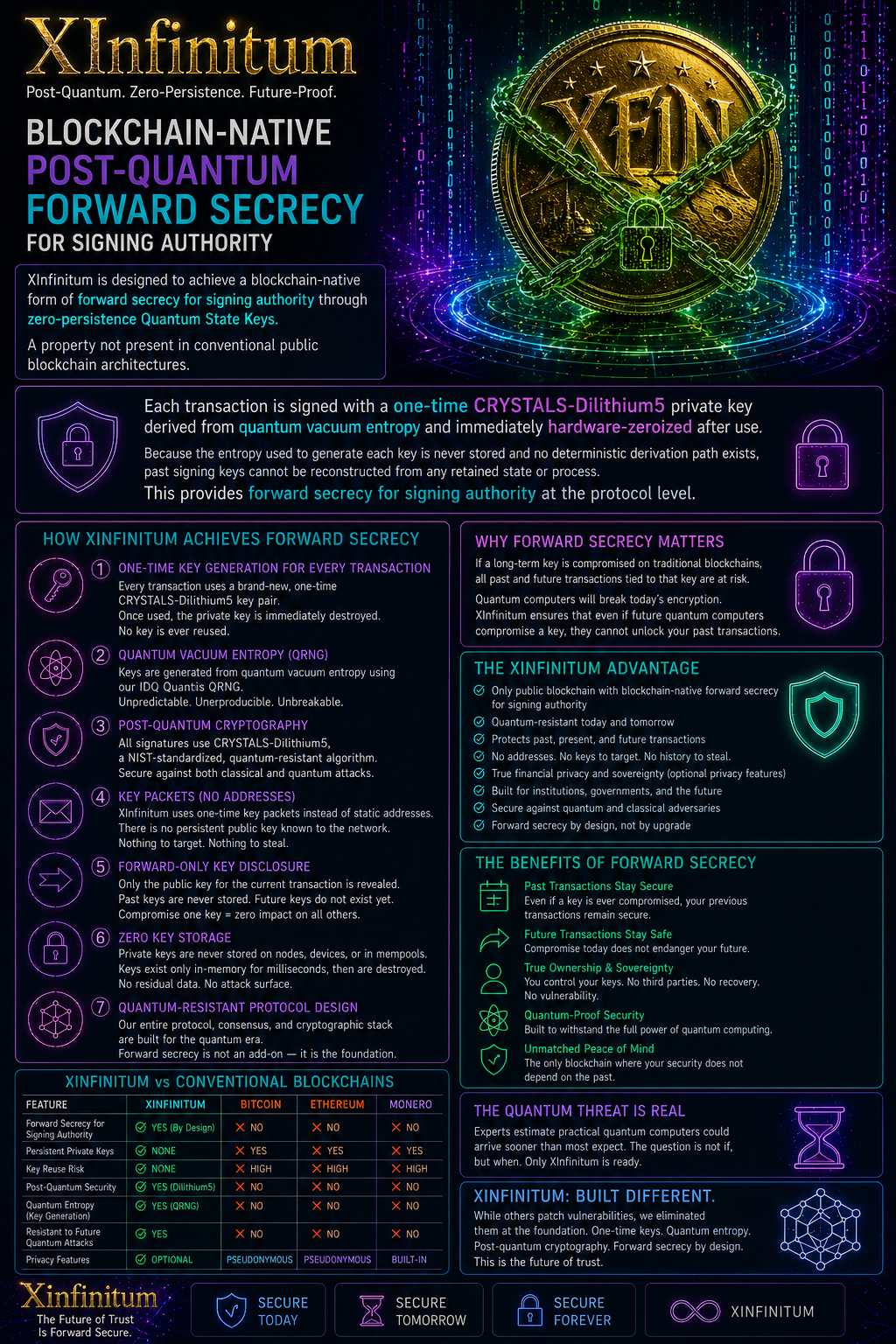
XInfinitum is designed to be the first public blockchain to achieve post-quantum forward secrecy for signing authority at the individual transaction granularity — a security property stronger than anything offered by existing blockchains, messaging protocols, or financial systems.
What Perfect Forward Secrecy Means
Perfect Forward Secrecy is a guarantee about your history. It answers the question: "If an adversary compromises something today, can they reach backward and expose what I did before?"
On Bitcoin, Ethereum, Solana, and every other major blockchain today, the answer is yes. Each wallet has one keypair that signs every transaction it ever makes. That single key protects your entire transaction history — past, present, and future. If that key is ever compromised through theft, forensic analysis, a hardware vulnerability, or a future quantum computer using Shor's algorithm — every transaction you have ever made is exposed simultaneously.
Nation-state intelligence agencies are already exploiting this through harvest now, decrypt later strategy: recording blockchain data and signed transactions today, then waiting until quantum computers powerful enough to break ECDSA become available. Every Bitcoin and Ethereum transaction ever broadcast is potentially sitting in an archive, waiting for the decryption technology to arrive.
XInfinitum's Quantum State Keys eliminate this attack surface completely. Because every transaction is signed by a key that is generated and destroyed within the same atomic operation, there is no key to harvest, no archive to decrypt, and no historical exposure to worry about — ever.
Why Other Blockchains Cannot Offer This
- A different key per transaction: Using a different signing key for every transaction means no single compromise exposes multiple transactions. Classical blockchains use one keypair forever, by design.
- True random entropy per signing event: The per-transaction key must be derived from entropy that did not exist before the transaction and cannot be reproduced. Algorithmic pseudorandomness (PRNG) fails this test.
- Verified hardware destruction: The ephemeral private key must be confirmed gone by hardware, not merely deleted by software. Software deletion leaves memory residue recoverable by forensic tools.
| Property | Bitcoin / Ethereum | Messaging (TLS 1.3) | XInfinitum QSK |
|---|---|---|---|
| Keys per session/transaction | One key — forever | Ephemeral per session | Ephemeral per transaction |
| Entropy source | Software PRNG / seed phrase | OS CSPRNG | Hardware QRNG — quantum vacuum |
| Key destruction | Never — key persists indefinitely | Software — OS managed | Hardware zeroization · SLE97 EAL6+ · MCU-verified |
| Quantum-resistant signature | No — ECDSA breakable by Shor | Partially (depends on suite) | Yes — CRYSTALS-Dilithium5 (NIST Level 5) |
| Forward secrecy scope | None | Session-level | Per-transaction — maximum granularity |
| Historical exposure on compromise | All past & future transactions | Prior sessions safe (computational) | Zero — past keys do not exist |
| Harvest-now-decrypt-later resilient | No | Partially (session keys ephemeral) | Yes — no key material ever persists in any form |
7.5 Signing Tiers
Biometric input is not required to transact on XInfinitum. Biometric verification is required only for features that assert unique human identity — specifically, Praemium Program enrollment and DAO governance voting. The core security property — ephemeral, quantum-derived, single-use keys — is fully preserved at every tier.
| Signing Tier | Who | Entropy Source | Biometric | Use Cases |
|---|---|---|---|---|
| Tier 1 — Hardware | Human with PALLAS QSSK | On-device hardware QRNG (ID Quantique IDQ6MC1) | Required — hardware liveness detection inside secure element | All transactions + Praemium enrollment + DAO governance voting |
| Tier 2 — Software | Human, software wallet | QRNG API (ID Quantique cloud / ANU QRNG) | Optional — device biometric via phone TEE | Standard transactions; not eligible for Praemium or governance without hardware or KYC |
| Tier 3 — Programmatic | AI validators, smart contracts, automated signers | QRNG API | None | Block validation votes, consensus messages, reward distributions, contract execution |
8 · Token & Tokenomics
| Parameter | Value |
|---|---|
| Name | XFIN |
| Network | XInfinitum (native L1) |
| Total Supply | 1,000,000,000 XFIN — hard cap, permanently fixed |
| Decimals | 22 |
| Base unit | 1 Quantum = 0.0000000000000000000001 XFIN (10⁻²²) |
| Supply type | Fixed cap with mild deflationary pressure via fee burn (3% of every fee burned) |
8.1 Token Distribution
| Allocation | Amount (XFIN) | % | Notes |
|---|---|---|---|
| Staking & Liquidity Rewards Pool | 400,000,000 | 40% | Distributed over 15 years, declining schedule |
| Ecosystem & Developer Grants | 200,000,000 | 20% | DAO-controlled, milestone-gated |
| Team & Founder | 100,000,000 | 10% | 4-year vesting, 1-year cliff, monthly unlock |
| Public Token Sale (ICO) | 100,000,000 | 10% | $0.50/XFIN ICO price |
| Pre-Sale | 100,000,000 | 10% | Seed $0.05/XFIN · Pre-sale $0.15/XFIN |
| Treasury (Foundation DAO) | 100,000,000 | 10% | DAO-governed operations, legal, R&D |
8.2 Token Utility
- Transaction fees (denominated in Quanta for micro-payments)
- AI validator staking (minimum $33,333 USD equivalent in XFIN — Bootstrap Grant Program available)
- Storage node staking (to host encrypted token shards)
- DAO governance voting (1 human = 1 vote, PALLAS QSSK biometric verification required)
- Liquidity pool participation and LP token staking
- DeFi protocol participation (lending, borrowing, yield farming)
- Fungible token issuance (deploy custom tokens using the XFIN token standard)
- NFT minting and trading (native NFT standard)
- Access to priority mempool lanes (optional fee premium)
9 · Fee Structure
XInfinitum fees are proportional to transaction value — not flat. Transactions of $25 USD or less are fee-free (base gas only) — making XInfinitum the optimal network for micropayments, tipping, and small remittances.
| Component | Rate | Recipient |
|---|---|---|
| Network fee | 0.0025% of USD transaction value | 50% validators · 37% staking & liquidity rewards · 10% treasury · 3% burned |
| Wallet fee | 0.000625% of USD value (25% of network fee) | 100% wallet operator |
| Base gas | 0.00005 XFIN flat (all transactions) | 50% validators · 37% staking & liquidity rewards · 10% treasury · 3% burned |
| Free tier | Transactions ≤ $25 USD | Percentage fee waived; base gas only |
| Enhanced Privacy surcharge | +0.0035 XFIN flat | Covers ring signature + ZK proof compute |
9.1 Competitive Comparison — $250 Remittance
| Provider | Fee | % of $250 |
|---|---|---|
| Western Union | ~$12.50 | 5.0% |
| Bank wire / SWIFT | ~$25–45 | 10–18% |
| Bitcoin | ~$1.00 | 0.4% |
| XInfinitum | $0.0078 | 0.00313% |
XInfinitum is 1,600× cheaper than Western Union on a $250 remittance. The recipient's family keeps an extra $12.49 per transfer — $149.88/year at one transfer per month.
10 · Staking & Rewards
| Staking Type | Base APY | Lock Period |
|---|---|---|
| Flexible staking | 5.0% | None — withdraw anytime |
| Liquidity pool participation | 7.7% | None |
| LP token staking | 8.0% | None |
| AI Validator staking | 25–40% estimated | 1 year minimum (includes slashing risk) |
10.1 Extended Lock Multipliers
| Lock Period | Multiplier | Flexible (5%) | LP Part. (7.7%) | LP Token (8%) |
|---|---|---|---|---|
| 1 year | 1.3× | 6.5% | 10.0% | 10.4% |
| 1.5 years | 1.6× | 8.0% | 12.3% | 12.8% |
| 2 years | 1.9× | 9.5% | 14.6% | 15.2% |
| 2.5 years | 2.2× | 11.0% | 16.9% | 17.6% |
| 3 years | 2.5× | 12.5% | 19.3% | 20.0% |
Multipliers apply to accumulated rewards only — staked principal is always returnable in full at end of lock period. Early unlock is permitted; however, 50% of accumulated rewards earned to date are forfeited and redistributed to the staking rewards pool. Principal is never at risk from an early exit.
11 · The XInfinitum Praemium Program
XFIN — The Cryptocurrency That Pays You.
One human. One wallet. One equal share. Every month.
The XInfinitum Praemium Program is a foundational economic feature made possible exclusively by the AI consensus architecture. After AI validators pay their verified compute costs, everything left over belongs to the network's people — divided equally, every month, automatically.
This program cannot exist on a proof-of-work or proof-of-stake chain. In both models, all surplus revenue flows to miners or stakers in proportion to capital investment. In XInfinitum's AI consensus, validators are software agents whose entire economic requirement is their verified compute cost. Any earnings above those costs represent genuine network surplus — which the Praemium Program distributes equally to every verified human on the network.
11.1 Proof of Personhood
- Tier 1 — PALLAS QSSK Device Enrollment (Automatic): Holders of PALLAS QSSK hardware devices are automatically eligible. The biometric verification is performed on-chip; no biometric data leaves the device. Hardware enforces one-person-one-wallet at the physical layer.
- Tier 2 — KYC Identity Enrollment (Universal Access): Any government-issued ID from any jurisdiction accepted. Free of charge. The KYC service generates a Zero-Knowledge Enrollment Proof — proving "this wallet belongs to a unique verified human" without revealing who. The identity document is permanently deleted after verification.
11.2 Projected Monthly Distributions
| Network Scale | Daily Transactions | Monthly Surplus | Per Address / Month | Per Address / Year |
|---|---|---|---|---|
| Early Stage | 1,000,000 | ~$600 | ~$0.00012 | ~$0.04 |
| Growth Phase | 10,000,000 | ~$8,000 | ~$0.0016 | ~$0.58 |
| Streaming Scale | 100,000,000 | ~$92,000 | ~$0.018 | ~$6.60 |
| Mature Network | 500,000,000 | ~$475,000 | ~$0.095 | ~$34 |
| Full Scale | 1,000,000,000+ | ~$950,000+ | ~$0.19+ | ~$69+ |
Assumes average transaction fee of $0.001 USD and 5,000,000 enrolled addresses.
12 · Governance — The XInfinitum Foundation DAO
XInfinitum is built by Pilon Laboratories Inc., a private Canadian corporation. Protocol governance is progressively transferred to the XInfinitum Foundation DAO as network milestones are achieved.
| Phase | Control |
|---|---|
| Phase 1 — Testnet | Pilon Labs holds full protocol control |
| Phase 2 — Mainnet | DAO controls validator admission and treasury |
| Phase 3 — Growth | DAO controls protocol parameters and upgrades |
| Phase 4 — Maturity | Full DAO governance; Pilon Labs = service provider only |
12.1 DAO Participation
DAO governance requires: (1) minimum staked XFIN equivalent to $10,000 USD; (2) registered PALLAS QSSK device with biometric verification at time of voting; (3) on-chain biometric commitment. Every qualifying participant receives exactly 1 vote regardless of stake amount — wealth buys more yield, not more governance influence.
12.2 Proposal Thresholds
| Proposal Type | Fee | Quorum | Approval |
|---|---|---|---|
| Parameter adjustment | $50 USD equiv. in XFIN | 5% | 60% |
| AI model training approval | $75 USD equiv. in XFIN | 7% | 66% |
| Protocol upgrade | $120 USD equiv. in XFIN | 10% | 75% |
| Constitutional amendment | $150 USD equiv. in XFIN | 20% | 80% |
13 · Security Model & Post-Quantum Cryptography
| Function | Algorithm | Standard |
|---|---|---|
| Transaction signatures | CRYSTALS-Dilithium5 (ML-DSA) | NIST FIPS 204 · Level 5 |
| Key encapsulation | CRYSTALS-Kyber (ML-KEM) | NIST FIPS 203 |
| Token storage encryption | CRYSTALS-Kyber + AES-256-GCM | NIST FIPS 197 |
| Shard distribution | Shamir Secret Sharing (3-of-5) + decoy shards | Information-theoretic security |
| zkML proofs | PLONK universal proof system | ZK-SNARK |
| Entropy source | QRNG — ID Quantique Quantis / ANU API | NIST SP 800-90B |
| Hashing | SHA3-256, SHA3-512 | NIST FIPS 202 |
| Key derivation | HKDF-SHA3-512 | RFC 5869 |
13.1 Perpetual Token Encryption Architecture
XInfinitum tokens are never stored in plaintext anywhere on the network at any time. Every XFIN token in existence undergoes the following lifecycle immediately upon issuance and remains in this state permanently:
- Compression: Token data is compressed before encryption to reduce shard size and network overhead.
- Encryption: Each token is individually encrypted using CRYSTALS-Kyber key encapsulation + AES-256-GCM symmetric encryption. The encryption key is derived from network consensus entropy — no single party holds it.
- Sharding: The encrypted token is split into shards using Shamir Secret Sharing (3-of-5). Any 3 shards can reconstruct the token; 2 or fewer shards reveal nothing.
- Decoy shard injection: For every real shard distributed to the network, additional cryptographically indistinguishable decoy shards are distributed alongside it. An adversary cannot distinguish real shards from decoys.
- Distribution: Real and decoy shards are distributed across geographically diverse storage nodes. No single node holds a complete token or enough real shards to reconstruct one.
14 · Network Phases & Roadmap
| Phase | Target | Key Milestones |
|---|---|---|
| Phase 1 — Testnet | 2026 | 7 AI validators · zkML proof system · PALLAS QSSK wallet integration · Praemium enrollment testing · Software QRNG mode |
| Phase 2 — Mainnet Genesis | 2027 | 15 validators · Public token launch · Praemium Program live · DAO treasury control · XFIN exchange listings · XInfinitum Foundation incorporated (Cayman Islands) |
| Phase 3 — Growth | 2028 | 51 validators · EVM compatibility layer · DEX launch · Expanded privacy tooling · XInfinitum Card Program · XFINUSD stablecoin launch · XFIN perpetuals market |
| Phase 4 — Maturity | 2029+ | 100+ validators · Full DAO governance · L2 rollup support · .xinfinitum domain service · zkML ASIC hardware · XFINCAD stablecoin · THORChain-style native BTC/ETH swaps |
15 · Planned Protocol Extensions
15.1 XFINUSD & XFINCAD — Delta-Neutral Stablecoins
XInfinitum plans to launch two native delta-neutral stablecoins in Phase 3: XFINUSD (pegged to the US Dollar) and XFINCAD (pegged to the Canadian Dollar). Unlike centralized stablecoins such as USDC or USDT — which require trust in a bank custodian and are subject to account freezes, debanking risk, and regulatory seizure — XInfinitum stablecoins are maintained entirely on-chain through a hedged collateral mechanism.
15.1.1 How Delta-Neutral Pegging Works
- User deposits XFIN as collateral into the stablecoin protocol smart contract.
- The protocol simultaneously opens a short position on an equivalent XFIN value via the XInfinitum perpetuals market — cancelling out price exposure.
- XFINUSD or XFINCAD is minted to the user in the equivalent pegged amount.
- Redemption reverses the process — stablecoin is burned, short is closed, XFIN collateral is returned.
15.1.2 Why XFINCAD Is Strategically Significant
No major blockchain currently has a widely adopted, natively issued CAD-pegged stablecoin. XFINCAD would be the first serious Canadian-dollar stablecoin on a purpose-built Layer 1 — directly aligned with Pilon Laboratories' Canadian origin, and positioned to attract Canadian institutional participants, remittance corridors, and regulated financial services that require CAD settlement.
15.2 XInfinitum Card Program
| Card Type | Fee | Features |
|---|---|---|
| Virtual Card | $9.00 CAD / year | Instant issuance · Online payments · Apple Pay / Google Pay compatible |
| Physical Card | $22.00 CAD one-time | Tap-to-pay NFC · Worldwide acceptance · Apple Pay / Google Pay compatible |
15.2.1 PALLAS QSSK — NFC Payment Integration
The PALLAS QSSK hardware device is designed with an NFC module, enabling it to function as a contactless payment device at any NFC-enabled terminal. Payment is triggered by the biometric fingerprint sensor — the same liveness-verified touch that authorizes all other device functions. Card credentials are tokenized inside the secure element before transmission, matching the security model of Apple Pay.
16 · Revenue Model & Network Economics
XInfinitum generates protocol revenue through five independent streams. These streams are structurally separate — no single stream's performance affects the others, and each feeds into distinct network pools (validator rewards, treasury, Praemium, burn).
16.2 Address Shortening Service — .xfin Domains
| Tier | Annual Fee | Description |
|---|---|---|
| Standard address (5+ characters) | $7.00 USD/year | e.g. derek.xfin, alice.xfin |
| Short address (3–4 characters) | $35.00 USD/year | e.g. ace.xfin, zk.xfin |
| Single character (1–2 characters) | $200.00 USD/year | Reserved for auction; high-demand identifiers |
16.6 Projected Revenue Summary
| Stream | Phase 2 (2027) | Phase 3 (2028) | Phase 4 (2029+) |
|---|---|---|---|
| Network transaction fees (treasury 10%) | ~$50K/mo | ~$500K/mo | ~$5M+/mo |
| .xfin address registrations | — | ~$100K/mo | ~$700K+/mo |
| PALLAS Wallet App fees | ~$20K/mo | ~$200K/mo | ~$2M+/mo |
| XInfinitum Card fees | — | ~$75K/mo | ~$300K+/mo |
| Stablecoin protocol fees | — | ~$250K/mo | ~$3M+/mo |
Revenue figures are forward-looking estimates based on comparable network growth trajectories and do not constitute a guarantee of future performance. All figures in USD equivalent.
17 · PALLAS QSSK — Quantum State Security Key Hardware Device
The PALLAS QSSK hardware device is the physical embodiment of the Quantum State Key protocol. Manufactured by Pilon Laboratories Inc. under the PALLAS product line, it provides the highest security tier for XInfinitum wallet operations and serves as the hardware Proof-of-Personhood credential for DAO governance and Praemium enrollment.
- Embedded QRNG: ID Quantique IDQ6MC1 — certified quantum entropy, physically non-deterministic
- Secure Element: Infineon SLE97 · Common Criteria EAL 6+ — all key operations inside the SE, never exported
- Biometric sensor: Synaptics FS7600 · Hardware liveness detection — single biometric = single governance identity
- Signature algorithm: CRYSTALS-Dilithium5 (NIST FIPS 204) — quantum-resistant at Level 5
- Multi-function: XInfinitum hardware wallet · FIDO2 security key · Encrypted data vault · NFC payment terminal